
Fees, Fees, please no more fees…

I was talking to a colleague yesterday about the fees he incurred to purchase one $27.00 concert ticket. After the fee and order charge (which totaled $12.00) the ticket cost was $39.50, and that was using will call, so no shipping fees. So my question is: what does the $8.50 and $3.00 go to? Why not just post the tickets as $39.50? Is it like a plane ticket where depending on the website you purchase from, you sometimes have to wait until the final screen to know how much you are really paying in taxes + fees?
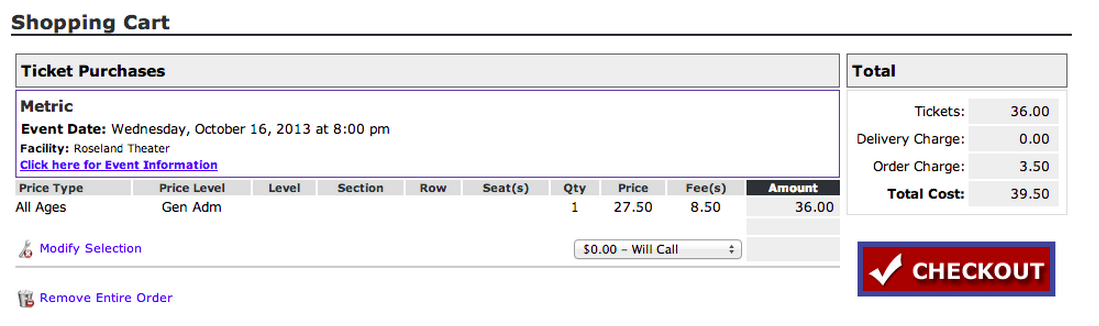
Fees and taxes seem to be on the rise across many industries. We all know the crazy airline fees and taxes we have had to pay in recent years. I am not sure many of us even understand what we are truly paying for when we purchase a ticket. Add on to that a hotel room, or a rental car. After you add-on the taxes and fees, it often feels like you have paid twice as much. It seems like it would be easier to just give the price to the customer inclusive of all the taxes and the fees. Although just a few weeks ago, airlines rolled out new fees that are supposed to make travelers happy. This article states:

“Extra legroom, early boarding and access to quiet lounges were just the beginning. Airlines are now renting Apple iPads preloaded with movies, selling hot first class meals in coach and letting passengers pay to have an empty seat next to them. Once on the ground, they can skip baggage claim, having their luggage delivered directly to their home or office.”

Now we pay extra taxes and fees when we purchase a ticket, to bring extra baggage, and for the luxury to not have to share the seat next to you. What will be next? Purchase an entire row so you can stretch out?

The path of least resistance?

How often do you pursue an issue not because of the money you save, but because at the end of the day your decision to dig deeper has more to do with principle?

These past few weeks it seems there have been quite a few issues Chris and I have run into where we have to stay adamantly persistent to get to the bottom of an issue due to the principle behind the situation. We always ask ourselves, will fighting this potentially help someone else in the future? If we resolve this, could it mean that maybe what happened to us will not happen to someone else?

Often I think individuals just want to find the path of least resistance, yet that can be the easy way out. The harder, more involved, and sometimes frustrating path is to hold companies and individuals accountable for the mess they sometimes make. I will give you an example. Our company covers one preventative exam per year (per individual covered). It is free. This year Chris went to a different location for his check up. It was one of those quick places, that you just walk in. Quick and easy. Or so he thought.

After the specific provider forced him to pay his co-pay, he remembered that his preventative exam was free. Phone call after phone call to our insurance provider and the medical care provider to hopefully resolve the issue, what he found out was that while this medical provider was “in-network,” yet they were also listed as an “emergency care” provider. The contract between our insurance company and this medical care provider was that copays only apply for non emergency care providers, yet this is not disclosed to us. Based on that, and the contract they had with our company, we were required to pay the copay. Obviously a loophole.

After many hours and phone calls later it is finally resolved. We received a refund of our copay, after our company got involved with our complaint. While this was for a small amount of money, what if it was for $20,000? Does the amount really matter? Is it more about principle? $1 or $100, or $1,000? We should hold others accountable in hopes that we make life easier for individuals in the future.

What do you think?

Oh how I hate hold music.

How often do you call your cable company, or your credit card company and either have to listen to a zillion annoying little prompts to get to where you want to go, or you wait on the line for what feels like eternity only to listen to their hold music?

I can adamantly say that I have never once said to anyone: “Oh, xxxx company has the most amazing hold music.” Why is that? Why is waiting on hold to be helped so excruciatingly painful? Do they hope that most of us will hang up the phone out of boredom, anguish, and insanity and instead go online and send them an email? I try to do that as much as possible, but there are just certain things that need to be handled by a live person. I will give you a few examples:

_When your cable company (ahem, Comcast) continues to screw up your bill every month since you moved in 10 months ago. No email will ever be able to truly shed light on your true frustration, only duking it out with a live person will hopefully grant you the discounts and offers you deserve.

_Anything having to do with financial information, credit cards, and bank accounts should be handled online. Yes I am old school. I prefer a live person to mess up my account, then a live person behind an email. At least I can ask for my phone call to be escalated, and hopefully my phone call was “recorded for quality purposes.”

_You enjoy connecting with other people, making their day, and generally being the world’s nicest customer. I know a few people who fit that description, and they are the cream of the crop. If only we could have their patience.

I digress. This all started out being about hold music. I still do not understand why they have not invented hold music that connects you to Pandora or Spotify and lets you jam to your current selection. Maybe customer service representatives will find their customers happier, more patient, and generally not going insane by hearing the same song for the 37 minutes they waited on hold. Of course that song was interspersed with a few ads for lower interest rates, or how you could be saved money, with the additional message of how many other customers are in front of you in the queue.

#needmorepatience4holdmusic

Start with the basics

Some of you that follow my blog know that I have a passion for money management. My passion evolved because I wanted to make sure that I truly understood what we were doing with our money, and that I trusted the information we were using to make our money decisions. I cannot do that in a vacuum. It means I have to read, learn, and ask the right questions. This recent Daily Worth had an idea that resonated with me:

“Money management is like cooking, or fixing a car or anything else you can learn,” says Myers. “But if you tell yourself you’re simply not good at it, you’re less likely to take steps to learn the basics you need to be financially healthy.”

I have to agree. While I am not a cook, I would feel comfortable calling myself a baker. I learned over time how to work with dough and understand why a recipe called for baking soda rather than baking powder. I am still learning new things about baking, and enjoy trying out new recipes. The same goes for money management. As the world changes and evolves fast, we have to shift and adjust with it, and be aware of whether the decisions we have made in the past continue to serve us, or if we need to adjust our financial allocations based on changes in the market, and our lifestyle.

Some individuals work with a financial planner that they trust, others rely on friends and family, and some look to books, the news, and the Internet to help inform them on what decisions they make regarding their money. Whatever step you take, I encourage you to continue to learn. Maybe you are young and a beginner, or you might have a family and are looking now at how to save for your children’s future, wherever you are in life, there is always something to learn that can benefit you today and in the future.

Opportunity Cost

Do you ever justify a purchase? Do you think to yourself, I worked hard this week, I deserve this purchase. Or, you might think about how you did not go out to dinner and a movie with friends last week, so you can buy this expensive coat. I justify purchases. Often it is that I should not purchase a specific item, either because we do not need it, or because I believe it is too expensive. Other times, I tell myself, if I purchase this, I will not purchase something else. Or, if I do not purchase something I can save for something better later.

A few weeks ago, I finished reading: “Decisive: How to Make Better Choices in Life and Work” by Chip Heath & Dan Heath. There was a quote that resonated with me:

“‘Opportunity cost’ is a term from economics that refers to what we give up when we make a decision. For instance, if you and your spouse spend $40 on a Mexican dinner one Friday night and then go to the movies ($20), your opportunity cost might be a $60 sushi dinner plus some television at home. The sushi-and-TV combo is the next-best thing you could have done with the same amount of time and money. Or if you love both shopping and hiking, then the opportunity cost of a Saturday afternoon at the mall might be the forgone opportunity to hike through a nearby park.” page 42

Is that how you make decisions in your life? Do you ever think about the opportunity cost for the choices you make? It is not always a bad way to make decisions. Chris and I spent a few years feeling stuck in the condo we owned. We knew we could not sell it due to the year we purchased it and the market, so we stayed put and continued to save for our future. Last fall we saw a window and found a house we fell in love with instantly. If we had not spent all those years saving, we would not have been able to make the move into our current home. I look at that as our opportunity cost. We stayed in a home for a few years and saved in order to now live in a home we love. It worked for us.

Is that how you look at money and decisions? Is it easier to have the opportunity right in front of you now, so you can see the instant gratification? Does that help you look into the future, or is what you want right now the only way to live? If you are diligent today, tomorrow, and the next day, could that give you more options in a few years? Yes. I can tell you that waiting often gives you more options, but not always. We have to listen for what makes the most sense in each situation. It will be different for everyone.

What do you think?